Environmental, Social and Governance (ESG) Planning
In the first article in this series I summarised the reasons we should take environmental sustainability seriously in our governance, while in the second I provided a short outline of the state of climate governance in Australia. In this article I want to talk about the most widely used framework for doing this work – what is called Environmental, Social and Governance (ESG).
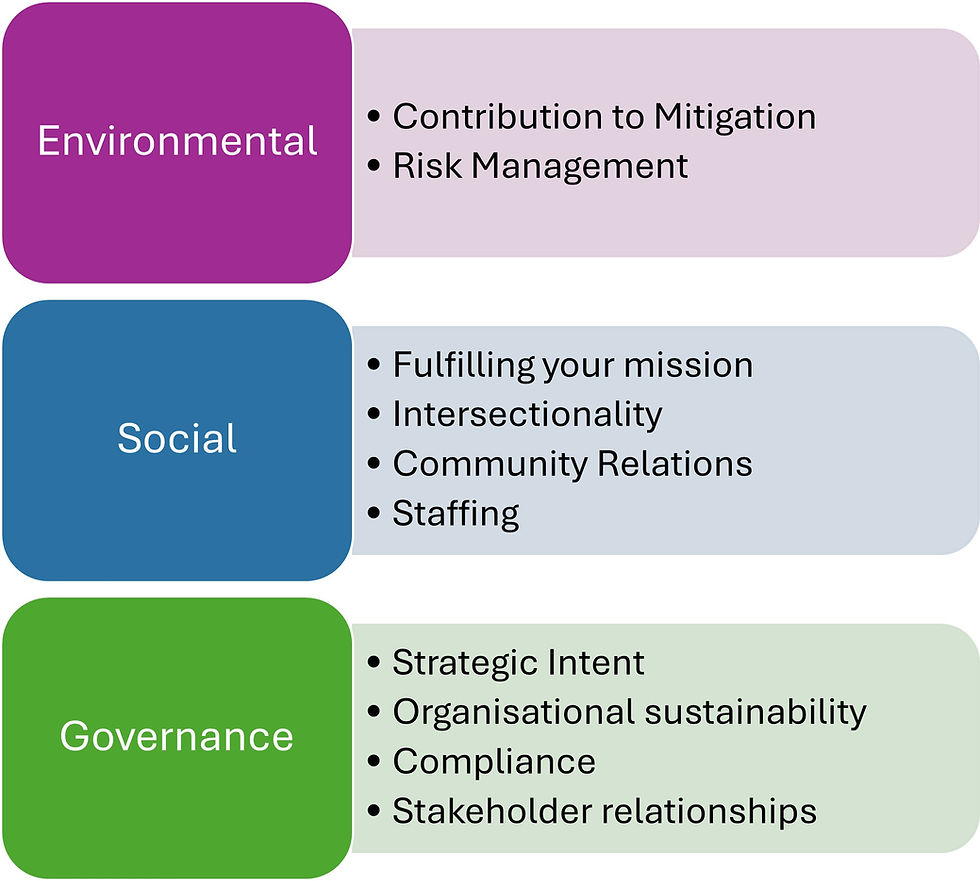
A quick disclaimer. Like all frameworks adopted from the for-profit sector, ESG can be an awkward fit for not-for-profit organisations. In the for-profit world it works to ensure corporations think about more than the bottom line. Not-for-profits do this as a matter of course since they exist to fulfil a mission. Nonetheless, it is a widely used and well-established framework so can serve as a good basis a board and leadership team to think beyond its core mission.
In their publication Purpose, people and planet: An environmental and social approach to sustainability in not-for-profits and charities, Chartered Accountants Australia and New Zealand summarise the concept like this:
“E = Environmental includes an organisation’s energy use and other resource consumption that impacts the natural world. This includes greenhouse gas emissions, water, waste and recycling and biodiversity loss.
S = Social refers to interactions an organisation has with employees, volunteers, suppliers, customers and clients and how its operations affect communities where it does business.
G = Governance refers to how an organisation, through its policies, practices and processes, makes decisions, complies with the law and interacts with external parties. It includes board composition, directors duties and governance frameworks that address anti-money laundering, fraud, bribery and corruption, whistleblower protections, and risk management. It includes respect for human rights, such as the eradication of modern slavery in the supply chain, work practices, health and safety, and diversity and inclusion.”
All three areas contain risks (to finances, reputation, compliance and service quality, among others) and opportunities (to improve services, attract new income streams, build partnerships and save money). Managing both the upside and the downside is part of good ESG planning.
Thinking Beyond ‘Core Business’, or doing it better?
One of the barriers for organisations considering taking on ESG is that it can seem like a diversion from ‘core business’. Our organisations exist to help people access secure affordable housing and exit homelessness, and we often do this with limited resources. Sometimes we are scrabbling just to meet our core obligations, and something like ESG can seem like a distraction. I would suggest that this is mis-conceived in two ways. Firstly, ESG need not be that hard, and we should be wary of making it into a mountain that we will struggle to climb. Secondly, doing ESG well can help us do our core business better, not be a distraction from it.
Various advisors on this, including Chartered Accountants Australia and New Zealand and the Institute of Community Directors Australia (ICDA), suggest the best way to approach this is to start with something you feel is small and manageable and raise your ambition over time as the practice becomes embedded.
To take the three parts of ESG in reverse order:
Governance
This is the most self-evident area – you need to be well governed to do your job well. You need to make sure that you have a clear strategy for your organisation, that you are compliant with a variety of laws and regulations including those outside your direct responsibilities, that your organisational policies and oversight are working properly, that your relations with wider stakeholders are positive and helpful, and that you are appropriately managing risks. Paying attention to all of these things will help you do your core work better.
In the context of an ESG plan, the role of governance (board and senior leadership) is to set and monitor strategy. ESG asks us to think beyond the moment and to look outside the small world of our own organisation to how we interact with the wider environment we work in. There is a lot of minutiae in governance - financial reports, risk registers, compliance checks and so forth - and these are important but they should not consume us totally. We also need to know where we are headed over the longer term, and how what is going on in the wider world might affect that.
Social
It can be tempting as social organisations to think we’ve got this covered because meeting social needs is what we do every day. However, the ‘S’ in ESG encourages us to think more broadly. We should be aware of the intersections of homelessness with wider social issues such as First Nations justice, gender equality, mental health and so on. ESG planning is a good opportunity to take a look at how the organisation interacts with these issues.
For example, we all know that First Nations people are hugely over-represented in the homeless population. Is your organisations successfully responding to this issue? Do you provide a culturally appropriate service? How well do your staff understand First Nations culture and the histories of the areas where you work? How good a relationship do you have with First Nations leaders in the communities where you operate? How successful have you been in attracting and retaining First Nations staff and Board members?
The same considerations apply to all of the issues that your tenants and clients face. I’m not breaking any new ground here – well-run housing organisations around the country are already doing this as a well-accepted matter of good practice. This is where the 'Social' part of ESG should take you.
Environmental
The ‘E’ in ESG will often be the hardest for an organisation to get to grips with, because it is the one we understand the least and feel is the furthest outside the organisation’s control. The key way to get past this barrier is to focus on things that are in our control.
ICDA suggests that across the not-for-profit sector, the two areas of climate change mitigation organisations have the most control over is their energy use, and their fleets. From a broader sustainability perspective I would suggest the other thing organisations can easily work on is waste management.
In energy, there are two things to pay attention to. First, if you have control of buildings is it feasible to install solar panels and battery storage? Leaving aside housing you own, which is more complex, it makes sense to start with your own office. If you can find the money up-front to install solar and batteries it is likely to pay for itself over time in reduced power bills while reducing your carbon footprint. If this is not possible, can you purchase green power, and how can you reduce your energy use? In this case you would look at various energy efficiency measures around appliances, lighting, heating and cooling. Taking both these options should be at least cost neutral over time and, done well, should reduce your operational costs.
The other area ICDA highlights is vehicles and particularly shifting from petrol or diesel vehicles to EVs. EVs are far cheaper to run then petrol or diesel vehicles, and purchase prices are rapidly coming down. Key barriers remain availability and access to charging infrastructure, but if you can solve both of these then shifting to EVs is a no-brainer. I would also say you should consider using bikes or e-bikes for shorter trips, but that’s just me!
In terms of waste management, the most straightforward thing to do is look at how you can reduce the amount of waste you create, and the amount you send to land-fill. Depending on where you are, you can gradually adopt measures such as reducing paper use, finding recycling outlets for plastics, used printer cartridges etc, composting food waste and many other things. These options also provide opportunities for partnerships with other organisations in the community, enhancing your reputation.
On the risk side, the most obvious impacts to manage are those related to extreme weather events – I’ve dealt with these in detail in a series of posts here. From a governance point of view the key instruments for dealing with these would be your Risk Management plan and your Business Continuity Plan, subject of an upcoming post in this series. Essentially, you would assess the key risks you are likely to face (floods? fires? storms?), what the impact is likely to be on your organisation and your clients/tenants, and what strategies you need to put in place to be prepared for if and when these events happen.
Measurement
A final aspect of ESG is how you measure your achievements. In my experience, this is the aspect of planning that Board members and organisational leaders struggle with the most, and often they end up with vague, subjective measures. Sometimes this is hard to avoid, but the more specific and concrete you make your measures, the easier it is to hold yourselves to account for their achievement. I’m a big believer in measuring the outcome not the process – so for instance rather than focusing on whether you took a set of steps you need to focus on whether you achieved the desired outcome.
Part of the key is to have only a small number of measures, and make them as simple and transparent as possible. On the environmental front, you could measure:
Reductions in power use, or energy bills.
Reductions in petrol expenditure.
Reductions in waste volumes going to landfill.
Of these, only the last would require any specific data collection and in this case the task would not be particularly onerous.
Social and governance measures can be more challenging but to stick with the example used above, you could measure the number of Aboriginal tenants you house and the rate at which they establish successful tenancies. The key is to make the measure specific to the issue you are trying to tackle, but not to sweat on the precise process it took to get there since you might modify the process as you go along.
The other worry that people have in setting measures is the worry about the consequences of failure to achieve the targets. For me there are two responses to this. The first is that if you don't have any clear targets you will never know if you actually achieved what you et out to. The other is that 'failure' is an opportunity for learning. The learning could be that you were overambitious and need to scale back, or alternately that you need to try different approach. Unless there is a regulatory or funding requirement attached to a measure (in which case you may indeed be punished for failure!) the measures are your own management tool to be used to help you do your job better, and you can use them in whatever way works best for you.
Keeping On Learning
A final thought on this. If you are new to ESG then your first foray into it is a great opportunity to learn, both individually as directors and leaders and collectively as n organisation. Take a bit of time to do some research, develop a set of goals which are within your capacity, and then check in 12 months time to see what you need to improve or redirect. over time it will become routine part of how you run your organisation, and it will help you to face the future with more knowledge and confidence.
Resources
Chartered Accountants Australia and New Zealand has produced “Purpose, people and planet: An environmental and social approach to sustainability in not-for-profits and charities” – you can download it here.
The Australian Government’s business.gov.au has a short introduction to ESG here.
The Institute of Community Directors Australia (ICDA) surveyed 570 not-for-profit directors in 2022 to assess their interest in and progress on adopting clean technology, with their report focused on EVs and solar and battery power. Their report is here. They have a template for a NFP Environmental Sustainability Policy here. They also have some handy resources on tackling climate change for NFPs and ESG.


Comments