Climate Change and Corporate Governance
In my previous post I talked a little about why climate change and sustainability are key governance issues. In this post, I want to briefly talk about the way this is being talked about and acted on in the wider corporate world, both for-profit and not-for-profit.

A lot of the focus in the media and in the climate activist community is understandably on the big climate polluters - the companies that mine or burn fossil fuels and the banks that fund them. This shows a pattern where companies set emissions reductions targets and then either abandon them, fail to meet them or have them called out as greenwashing. It's a depressing tale.
However, below the radar there is a steady shift towards company directors and regulatory bodies taking climate change seriously and working on ways to both manage their risks and make the most of the opportunities presented by decarbonisation. Here's some pointers to how this landscape is shifting.
Australian Institute of Company Directors (AICD)
The AICD is a professional body that supports company directors with training and resources. In 2021 and again in 2023, AICD partnered with Pollination to survey corporate directors on their views of climate governance. In the 2023 survey (reported in 2024) they surveyed 1,057 Australian company directors and conducted in-depth interviews with 24 of them. These include directors of ASX-listed companies, smaller companies, not-for-profits and government corporations. Some of their key findings were:
80% are concerned about climate change as a material risk
60% want their boards to pay more attention to climate governance
50% see nature and biodiversity as a material risk to their organisations
43% of listed and a quarter of unlisted companies have a transition plan and targets
32% are on boards that have reconsidered their organisational strategy in response to climate risk and opportunity
24% experience short-term financial demands from investors and shareholders as a barrier to climate governance
Listed directors (53% up from 37% in 2021) experience growing regulatory pressure
42% cite Australian policy uncertainty as the top barrier
26% are on boards that have invested in formal climate education
45% are confident in their board’s competence on the topic.
This suggests that while a large majority of directors are concerned about climate change, particularly as a risk factor, the performance of many of their boards and companies lags behind this concern - there is still more concern than action.
Their report highlights a number of emerging trends in climate governance, including:
Focusing on long-term outcomes and strategy, which can often require pushing back against pressure to be driven by the short-term.
Looking at climate change and decarbonisation as opportunities, not just as risks.
Treating climate as part of broader nature and sustainability strategies, not as an isolated issue.
Taking a 'whole-of-organisation' approach.
Having strategies that are concrete, evidence-based and transparent about costs and benefits.
Building industry coalitions rather than going it alone.
This feedback reflects two things - climate change is real and will change some of the ways we do our work, so we need to be concerned; and responses are challenging and require us to work and plan.
The AICD has also developed a set of Not-for-Profit Governance Principles, of which Principle 7 is 'Sustainability'.
“Sustainability refers to a focus by a board on how the organisation impacts, and is impacted by, the environmental, social and human elements that are central to its operations. Many NFPs describe sustainability from a traditional financial perspective as it relates to ensuring the organisation can sustain its operations over time. Broader sustainability considerations are often paramount governance issues as they go to the organisation’s risk profile, reputation and community standing. The approach to sustainability and what to focus on by a particular NFP will be guided by its purpose, size, complexity, industry, key stakeholders and the existing resources at its disposal. The board is central in deciding what sustainability matters are of importance having regards to the circumstances of the NFP and its purpose.”
This is a fairly unexceptionable principle but illustrates something I've seen a lot in reading about climate governance - the way discussion slips from climate change to 'sustainability' in a way that becomes much broader and more open to interpretation.
Institute for Community Directors Australia (ICDA)
The ICDA is kind of a smaller, less resourced counterpart to the AICD serving directors of not-for-profit organisations. They have a series of short resources for directors called '10 Questions' which includes two that are relevant to climate change.
“Ten questions every board director needs to ask about climate change” focuses on questions about climate risk, the readiness of the organisation to embrace change, the opportunities that exist for taking action and benefiting from this action, the impact of the wider government and policy environment and technology.
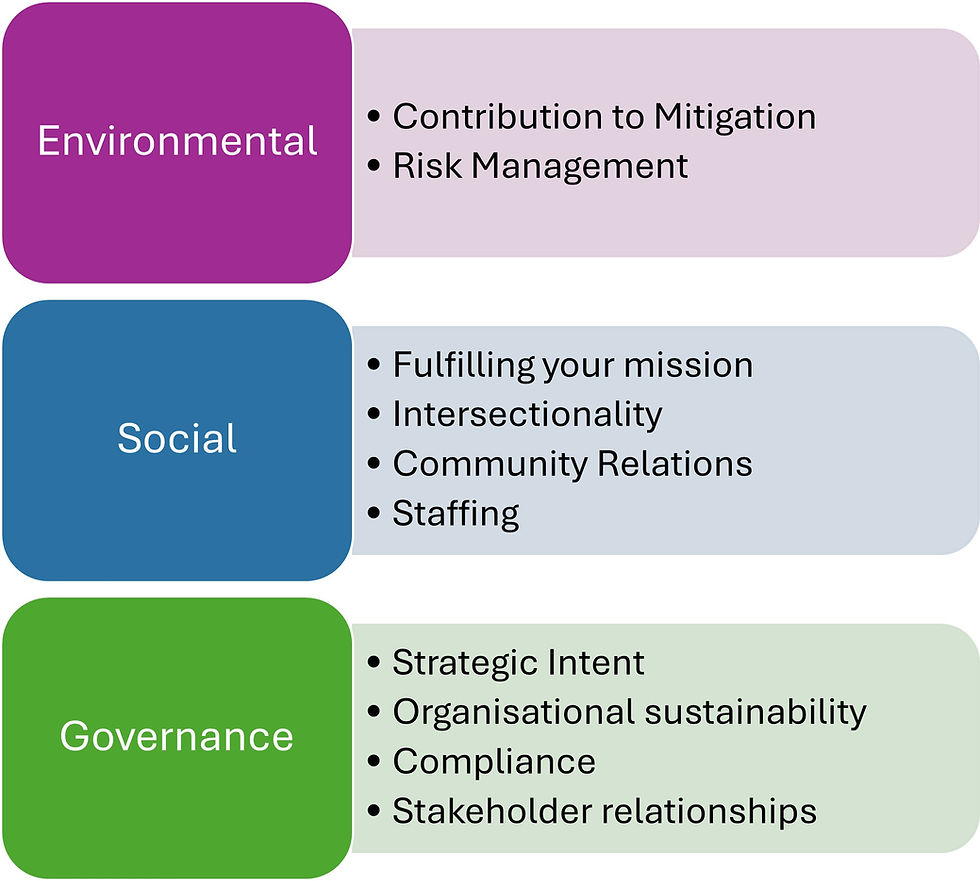
“Ten questions every board director needs to ask about ESG” is a simple guide to Environmental, Social and Governance Planning - I'll talk more about this in a later post.
Like the AICD, ICDA carried out a large-scale survey of its members (published in 2022) but focused on a narrower set of issues. It sought to test their current and potential contributions to decarbonisation, focusing on two key strategies - adoption of renewable energy (solar and batteries) and transition of their fleets to electric vehicles. They found strong enthusiasm for solar and batteries among those who owned or leased buildings, with over three quarters having either already installed these or positive towards doing so. On the other hand not many were advanced in electrifying their vehicle fleets, with only 8% of those who owned vehicles owning either an EV or hybrid. The main barriers to fleet transition were cost, availability of vehicles, and availability of charging infrastructure.
These examples show that ICDA is motivated to support its members to deal with climate change, but its output on this subject is rather patchy, largely reflecting its nature as a shoestring operation. It seems to me that in some ways this reflects the broader dilemma faced by not-for-profits, including housing and homelessness organisations. They know climate change is a serious issue and are motivated to respond to it, but they are stretched so thin achieving their core mission that there is not much money, time and energy left to get to grips with this complex set of issues.
Regulatory Environment
The final thing I'd like to draw attention to are developments in the corporate regulatory environment. In September 2024, the Australian Accounting Standards Board finalised two new standards.
AASB S1: General Requirements for Disclosure of Sustainability-related Financial Information is a voluntary standard for reporting risks and opportunities related to sustainability.
AASB S2: Climate-related Disclosures is a mandatory standard for certain classes of company with narrower focus on climate issues. This standard is being implemented in three phases between 2025 and 2027. When it is fully implemented it will apply to for-profit corporations which have two of the following - 100 or more employees, $25m or more in assets or $50m in consolidated annual revenue. Not-for-profit corporations are exempt from this standard and there are some more nuances about which smaller for-profit corporations are and aren't covered.
These standards are adapted from a set of international standards developed by the International Sustainability Standards Board and reflect the current state of reporting in many comparable nations. They are not mandatory for Community Housing Providers or homelessness organisations but the largest CHPs and homelessness charities would certainly be operating at the same scale as those caught under the mandatory standard. I'll try to give you a brief sense of these documents to illustrate the current state of play - nobody in their right mind would take accounting advice from me but if I was a director of a large housing or homelessness organisation I wouldn't be rushing to voluntarily adopt these standards.
Both documents are framed very similarly. Their purpose is "to require an entity to disclose information about its sustainability-related (or climate-related in AASB S2) risks and opportunities that is useful to primary users of general purpose financial reports in making decisions relating to providing resources to the entity." A report under these standards is meant to be an addendum to the general financial reports and to be delivered to shareholders and stakeholders at the same time.
There are four key elements that need to be disclosed:
"(a) governance—the governance processes, controls and procedures the entity uses to monitor and manage sustainability-related (/climate-related) risks and opportunities;
(b) strategy—the approach the entity uses to manage sustainability-related (/climate-related) risks and opportunities;
(c) risk management—the processes the entity uses to identify, assess, prioritise and monitor sustainability-related (/climate-related) risks and opportunities; and
(d) metrics and targets—the entity’s performance in relation to sustainability-related (/climate-related) risks and opportunities, including progress towards any targets the entity has set or is required to meet by law or regulation."
There's a lot of detail related to each of these elements - I won't go into it here, much of it is quite technical and it's mostly process-related. There's little to indicate what the content needs to be (not even a definition of 'sustainability') so this is left up to the discretion of the company within the overall framework sketched out here.
Some concluding thoughts
What this brief summary illustrates is that directors of large and small companies, for-profit and not-for-profit, are very aware that climate change will have impacts on their business. However, at this point their practice and strategy have yet to match their level of concern. People know that this is an issue, but many of their companies have yet to come to terms with how they should respond.
This is hardly surprising. Climate change presents a complex series of challenges. It can be hard to get to grips with exactly what the impact might be for your particular business, and making a contribution to decarbonisation may or may not come at a cost in the longer term but certainly requires up-front investment which companies may struggle to allocate. It can seem like a diversion from 'core business' and hence it can be tempting to ignore it or put it off. Or it can feel like walking up the stairs in the MC Escher drawing shown above!
However, it's not going to go away. Any responsible board would be wise to get to grips with it sooner rather than later.
Resources
The AICD's Climate Governance Study 2024 can be downloaded from here. Further information on the international Climate Governance Initiative is here. The NFP Governance Principles are here. AICD also has a range of resources on climate risk management which you can access here.
The ICDA survey of members is here. They have a range of resources for NFP Boards on climate change, ESG and a template for an Environmental Sustainability Policy.
The two AASB Standards can be downloaded from here. ASIC has a set of sustainability reporting resources here and EY also has an excellent short introduction to sustainability disclosures which you can download from here.


Comments